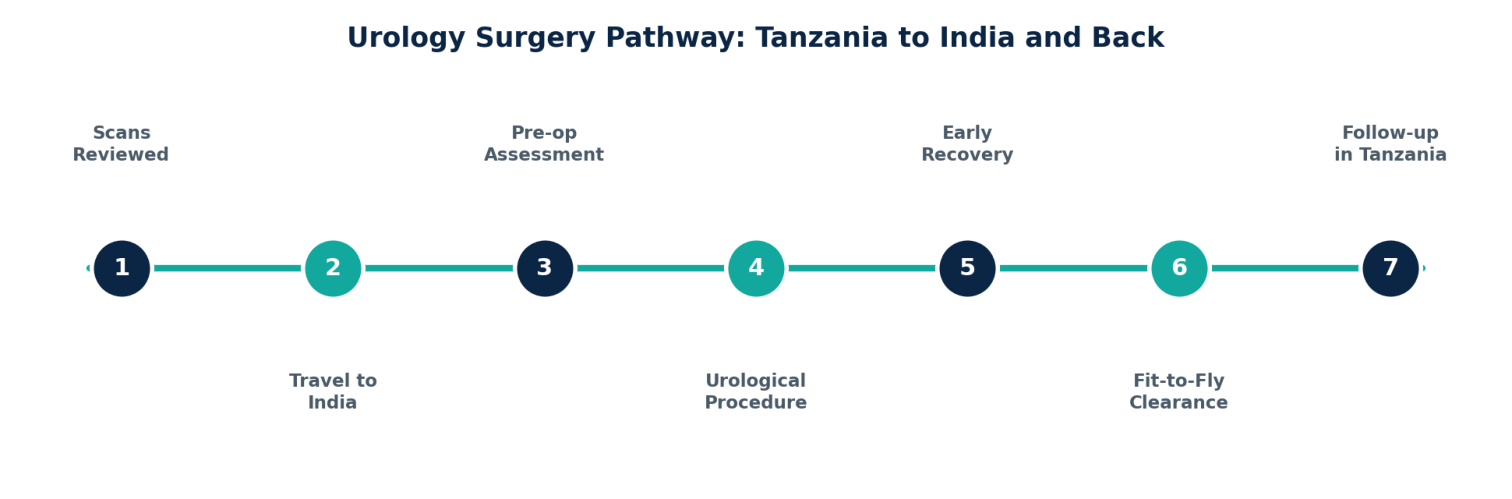
Urological surgery in India can suit Tanzania patients when the diagnosis is clear and surgery is genuinely needed — many kidney stones and prostate problems are first managed without an operation. India offers the full range from ureteroscopy, laser lithotripsy and PCNL to robotic prostatectomy, kidney surgery and reconstructive urology, with the right approach depending on your exact condition. Plan for recovery in India, catheter or stent care, fit-to-fly clearance, complete records and structured follow-up in Tanzania.
Guide Roadmap19 topics · 5 stages · tap to explore
For patients in Tanzania living with kidney stones, prostate disease, urological cancers, or other conditions of the urinary and male reproductive tract, surgery may become necessary when medication or minimally invasive measures are not enough. India offers a full spectrum of urological care — from endoscopic stone treatment to robotic prostatectomy, kidney surgery, and complex reconstructive urology — delivered in centres with dedicated robotic surgical platforms and high procedure volumes.
For a patient travelling from Tanzania, the important question is not simply “Can this be treated in India?” The more useful questions are: Do I actually need surgery? Is a minimally invasive or robotic option appropriate for my case? What are the risks? How long will recovery take? And when will I be fit enough to make the journey back to Tanzania? This guide explains the clinical aspects of urological surgery in India from the perspective of Tanzania patients.
1What Is Urology and Robotic Urological Surgery?
Urology covers the surgical and medical treatment of the kidneys, ureters, bladder, urethra, and the male reproductive organs. The objective depends on the diagnosis: clearing an obstructing stone, removing a tumour, relieving obstruction from an enlarged prostate, correcting a structural abnormality, or reconstructing damaged urinary tract anatomy. Increasingly, many of these procedures can be performed using laparoscopic or robotic-assisted techniques rather than traditional open surgery, depending on the condition and its extent.
2Common Urological Conditions for Which Tanzania Patients May Consider Treatment in India
Kidney and Ureteric Stones
Stones causing pain, obstruction or recurrent infection may be treated with shockwave therapy, ureteroscopy, or percutaneous surgery depending on size and location.
Benign Prostatic Enlargement (BPH)
Non-cancerous prostate enlargement causing urinary symptoms may be treated with medication or, when symptoms persist, minimally invasive or laser surgical procedures.
Prostate Cancer
Treatment options range from active surveillance for very low-risk disease to robotic or open prostatectomy, radiotherapy, or a combination, depending on risk category.
Kidney and Bladder Cancer
Tumours may require partial or complete removal of the kidney, or resection of bladder tumours, increasingly performed laparoscopically or robotically.
Urinary Incontinence and Pelvic Floor Disorders
Selected patients benefit from surgical procedures to restore continence when conservative treatment has not helped.
Congenital and Structural Urological Abnormalities
Conditions such as ureteropelvic junction obstruction may require reconstructive surgery, often performed robotically in experienced centres.
Male Infertility and Andrological Conditions
Selected structural causes of male infertility, such as varicocele, can be treated surgically.
3Does Every Condition Need Surgery?
No. This is one of the most important principles for a Tanzania patient considering travelling overseas. Depending on the diagnosis, appropriate non-surgical treatment may include:
Medication (for BPH, overactive bladder, or infection)
Dietary and fluid measures for stone prevention
Active surveillance for very low-risk prostate cancer
Shockwave lithotripsy instead of surgery for suitable stones
Pelvic floor physiotherapy for selected incontinence
A finding on ultrasound, CT or PSA testing does not automatically mean surgery is necessary. A urologist should evaluate whether the patient’s symptoms, test results and overall health justify intervention, and which type.
4When May Surgery Be Recommended?
Stones causing obstruction, infection, or that will not pass on their own
Cancer confined to the kidney, bladder or prostate that is amenable to surgical removal
Bothersome urinary symptoms not controlled by medication
Structural abnormalities causing recurrent infection or declining kidney function
Incontinence significantly affecting quality of life after conservative treatment has failed
5Warning Signs Tanzania Patients Should Not Ignore Before Travelling to India
Visible blood in the urine
Severe flank or abdominal pain, especially with fever
Inability to pass urine
Fever with urinary symptoms (possible kidney infection)
Unexplained weight loss with urinary symptoms
A patient with an acute urological emergency such as complete urinary retention or a kidney infection with fever should seek immediate local emergency care in Tanzania rather than delaying to arrange overseas treatment.
6Tests Usually Required Before Urological Surgery
Ultrasound
A first-line test for kidney stones, bladder abnormalities and prostate assessment.
CT Urogram
Provides detailed imaging of the kidneys, ureters and bladder, particularly for stones and tumours.
PSA and Prostate MRI
Used in the evaluation of prostate disease, including cancer risk assessment.
Cystoscopy
A camera-based examination of the bladder and urethra.
Urine Tests and Kidney Function Blood Tests
Assess infection, kidney function and overall fitness for surgery.
7Major Types of Urological Surgery Available in India
Ureteroscopy and Laser Lithotripsy
A telescope passed through the urinary tract to fragment and remove stones without external incisions.
Percutaneous Nephrolithotomy (PCNL)
A keyhole approach through the back to remove larger kidney stones.
Robotic-Assisted Prostatectomy
Robotic-assisted removal of the prostate for selected prostate cancer cases, offering enhanced precision for nerve-and continence-preserving surgery.
Robotic or Laparoscopic Partial/Radical Nephrectomy
Kidney tumour removal with preservation of healthy kidney tissue where possible.
Transurethral Resection (TURP/TURBT)
Endoscopic removal of prostate tissue or bladder tumours through the urethra, without external incisions.
Reconstructive Urological Surgery
Robotic or open repair of structural abnormalities such as ureteropelvic junction obstruction.
Can the Urologist Review My Scans While I Am Still in Tanzania?
Robotic-assisted platforms provide enhanced dexterity, 3D visualisation and precision, and are now widely used for prostatectomy, partial nephrectomy and selected reconstructive procedures. Robotic surgery is not automatically superior for every case — the right choice depends on tumour characteristics, anatomy, and the experience of the surgical team with the specific robotic procedure.
9Laser and Minimally Invasive Stone Technology
Advanced Indian urology centres use holmium and thulium laser systems for stone fragmentation, along with flexible ureteroscopes that can reach stones throughout the kidney. These technologies can reduce the need for open surgery in most stone cases. A useful question for Tanzania patients is not “Does this hospital have a laser?” but “Is this specific technology appropriate for the size and location of my stone?”
10Risks and Possible Complications of Urological Surgery
Infection
Bleeding
Injury to surrounding organs
Urine leakage
Stricture (narrowing) of the urinary tract
Erectile or continence changes after prostate surgery
Incomplete stone clearance requiring a further procedure
Anaesthesia-related complications
Recurrence of stones or tumour
The risk profile of a straightforward ureteroscopy is very different from that of robotic cancer surgery or complex reconstruction. Patients should request procedure-specific risk information rather than relying on generic complication percentages.
11Recovery After Surgery
Early Phase
Pain control
Catheter management where applicable
Wound monitoring
Early mobilisation
Monitoring of urine output and kidney function
Following Weeks
Catheter removal on the advised schedule
Progressive activity increase
Wound care
Medication adjustment
Monitoring for infection or stricture
Longer-Term Recovery
Most patients recover full urinary function within weeks of minimally invasive procedures, though continence and erectile function after prostate cancer surgery may take several months to fully stabilise.
12Recovery Support and Pelvic Floor Rehabilitation
Pelvic floor exercises where relevant (particularly after prostate surgery)
Hydration and dietary guidance for stone prevention
Gradual return to normal activity
Catheter care education
Psychological support where relevant (e.g. cancer diagnosis)
Long-term monitoring of kidney and bladder function
13When Can Patients Return to Work?
This depends on both the procedure and occupation. Many endoscopic stone procedures allow return to desk-based work within a week, while robotic prostate or kidney cancer surgery typically needs two to four weeks before returning to light work, and longer for physically demanding roles.
14How Long Should a Tanzania Patient Remain in India After Urological Surgery?
The appropriate period depends on the procedure, catheter management needs, wound healing, and risk of early complications such as bleeding or infection. A Tanzania patient should not book an inflexible return flight based solely on the expected hospital discharge date, particularly if a catheter needs monitored removal before travel.
15Flying Back to Tanzania After Urological Surgery in India
Fit-to-fly timing
Catheter status confirmation if applicable
Hydration
Blood-clot prevention
Medication timing
Airport wheelchair assistance if needed
Suitable seating
Access to a toilet during the journey
Patients travelling with a catheter or stent in place should confirm specific care instructions and any restrictions before flying.
16What Medical Information Tanzania Patients Should Bring Back from India
Discharge summary
Operative report
Final diagnosis and histopathology if applicable
Relevant imaging
Laboratory results (including PSA if relevant)
Catheter/stent details and planned removal date
Medication list
Follow-up schedule
Emergency warning signs
Treating urologist’s contact/follow-up pathway
17Follow-Up in Tanzania After Urological Surgery in India
Wound assessment
Stent/catheter removal coordination if not completed in India
Kidney function and urine tests
PSA or imaging surveillance if relevant
Medication review
Continence and sexual function review after prostate surgery
Long-term stone-prevention follow-up if relevant
18How Successful Is This Surgery?
There is no meaningful single “success rate” for urological surgery. Outcomes depend on the specific condition, stone size and location, cancer stage, age, and overall health. A straightforward stone procedure cannot reasonably be compared with robotic cancer surgery. Patients should be cautious about websites offering one universal success percentage.
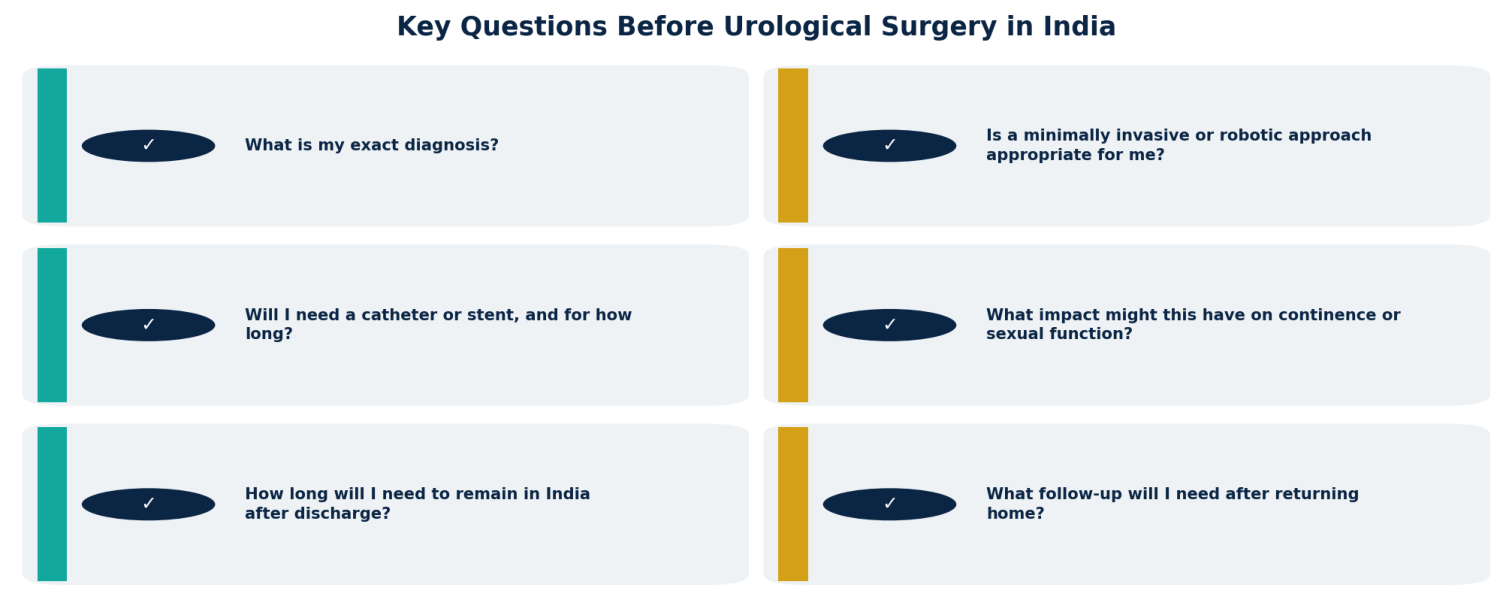
19Questions Tanzania Patients Should Ask Before Agreeing to Surgery in India
What is my exact diagnosis?
Is a minimally invasive or robotic approach appropriate for me?
What are the alternatives to surgery?
What are the major risks in my specific case?
Will I need a catheter or stent, and for how long?
How frequently do you perform this exact procedure?
What impact might this have on continence or sexual function?
How long will I be hospitalised, and how long in India afterward?
When will I be fit to fly back to Tanzania?
What follow-up will I need after returning home?
Frequently Asked Questions About Urology Surgery for Tanzania Patients in India
Can my scans be reviewed before I travel from Tanzania?
Often, yes. Digital imaging and reports can be reviewed remotely for an initial opinion, though a definitive plan usually requires in-person evaluation.
Does every kidney stone require surgery?
No. Many small stones pass on their own or are treated with shockwave therapy. Surgery is considered for larger stones, obstruction, or infection.
Is robotic surgery better than open surgery?
Not universally, but for many procedures such as prostatectomy it offers advantages in precision and recovery for appropriately selected patients.
Will prostate surgery affect continence or sexual function?
This is a real possibility that varies by individual anatomy and surgical technique; it should be discussed in detail beforehand.
How soon can I fly back to Tanzania?
There is no universal timeframe. Your urologist should clear you for travel based on wound healing, catheter status, and overall recovery.
What if I have already had urological surgery before?
Further or revision treatment is often still possible. Send previous records and imaging for assessment.
Should I choose a hospital based on its robotic technology alone?
No. Surgeon experience with the specific procedure and technology, correct diagnosis, and postoperative care remain fundamental.
Key Takeaway for Tanzania Patients Planning Urological Surgery in India
Travelling from Tanzania to India for urological surgery is a significant decision. The most important step is establishing the correct diagnosis and determining whether surgery is genuinely required, and whether a minimally invasive or robotic approach is appropriate. For a Tanzania patient, the treatment plan should also extend beyond the operating room to cover catheter management, recovery in India, fitness for travel, and a clear pathway for follow-up after returning home.
Citation Block: Tanzania Patients — Urology & Robotic Urological Surgery in India
Field
Details
Article / Topic
Urology and Robotic Urological Surgery in India for Tanzania Patients — Complete Clinical & Surgical Guide
Primary Patient Group
Tanzania patients with kidney stones, prostate disease, urological cancers or other urinary and male reproductive tract conditions
Key Clinical Principle
Confirm the diagnosis and whether surgery is genuinely needed before choosing any procedure or technology
Conditions Covered
Kidney and ureteric stones, BPH, prostate cancer, kidney and bladder cancer, incontinence, structural abnormalities and male infertility
Procedures Covered
Ureteroscopy and laser lithotripsy, PCNL, robotic prostatectomy, partial/radical nephrectomy, TURP/TURBT and reconstructive urology
Tests Before Surgery
Ultrasound, CT urogram, PSA and prostate MRI, cystoscopy, urine tests and kidney function blood tests
Technology
Robotic-assisted surgery, laser lithotripsy and flexible ureteroscopy, chosen to suit the condition
Typical Hospital Stay
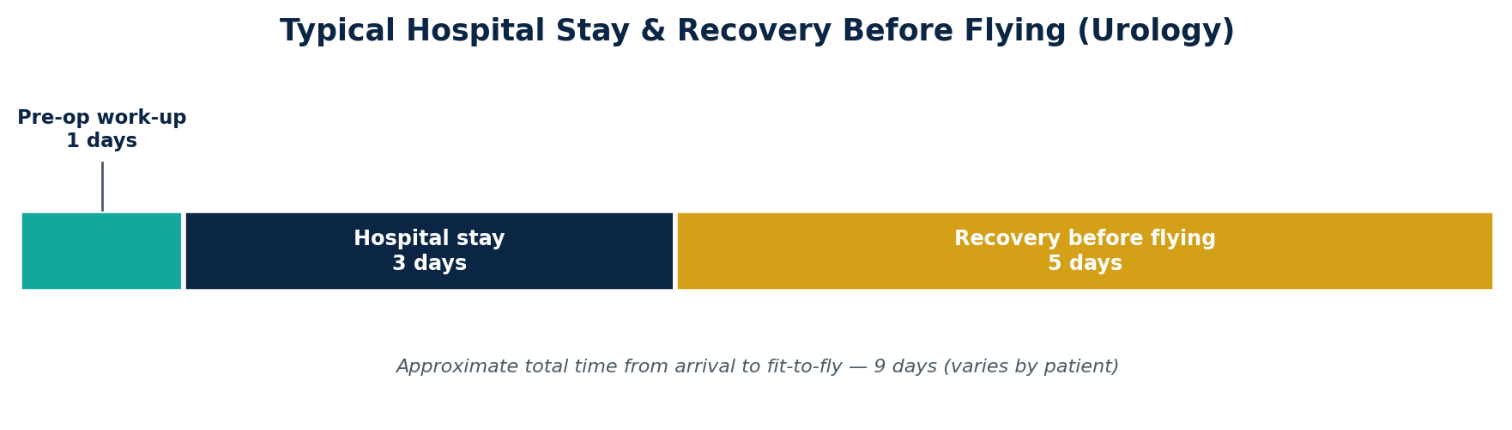
About 2–4 days after robotic urological surgery, depending on the procedure and recovery
Travel Home
Stay in India until fit-to-fly clearance and catheter/stent plans are settled; take records and imaging back to Tanzania
Key Decision Factor
Right diagnosis, right procedure, experienced urologist, appropriate technology and a clear follow-up plan in Tanzania
Tanzania Patients — Ready to Take the First Step?
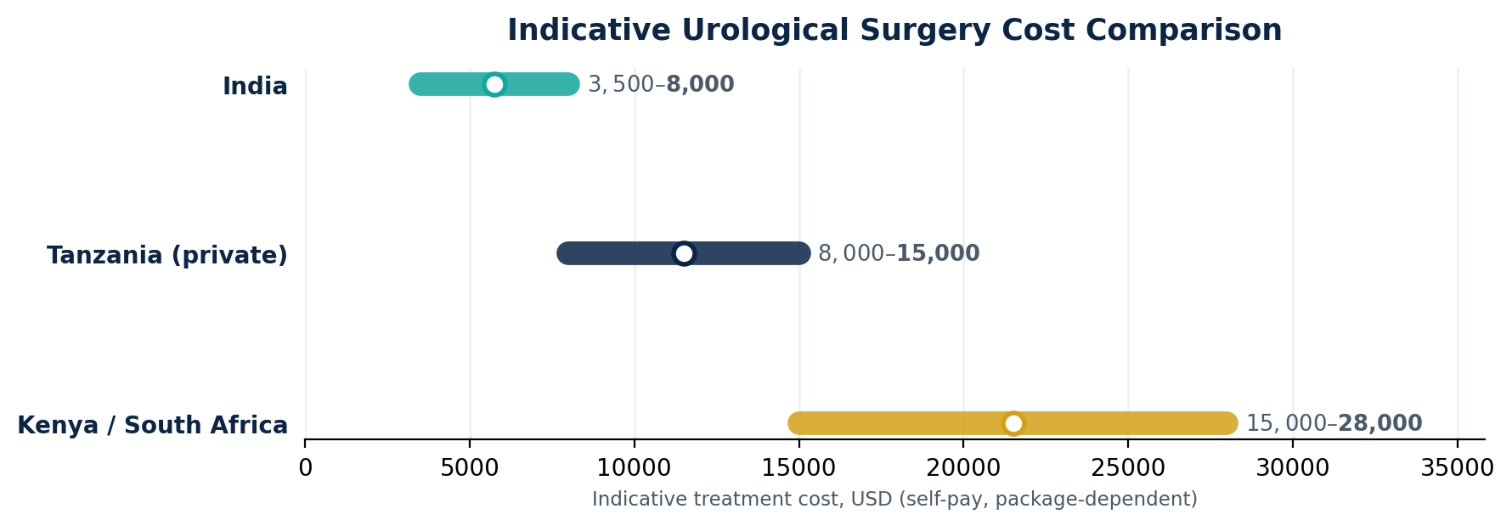
Share your medical reports from Tanzania with our advisory team today and get a MEDICAL CONSULTATION, an indicative cost estimate in US$, and complete support — from your flight out of Dar es Salaam to your recovery in India and follow-up back home.

 Clinical Guide · Part 1 of 5